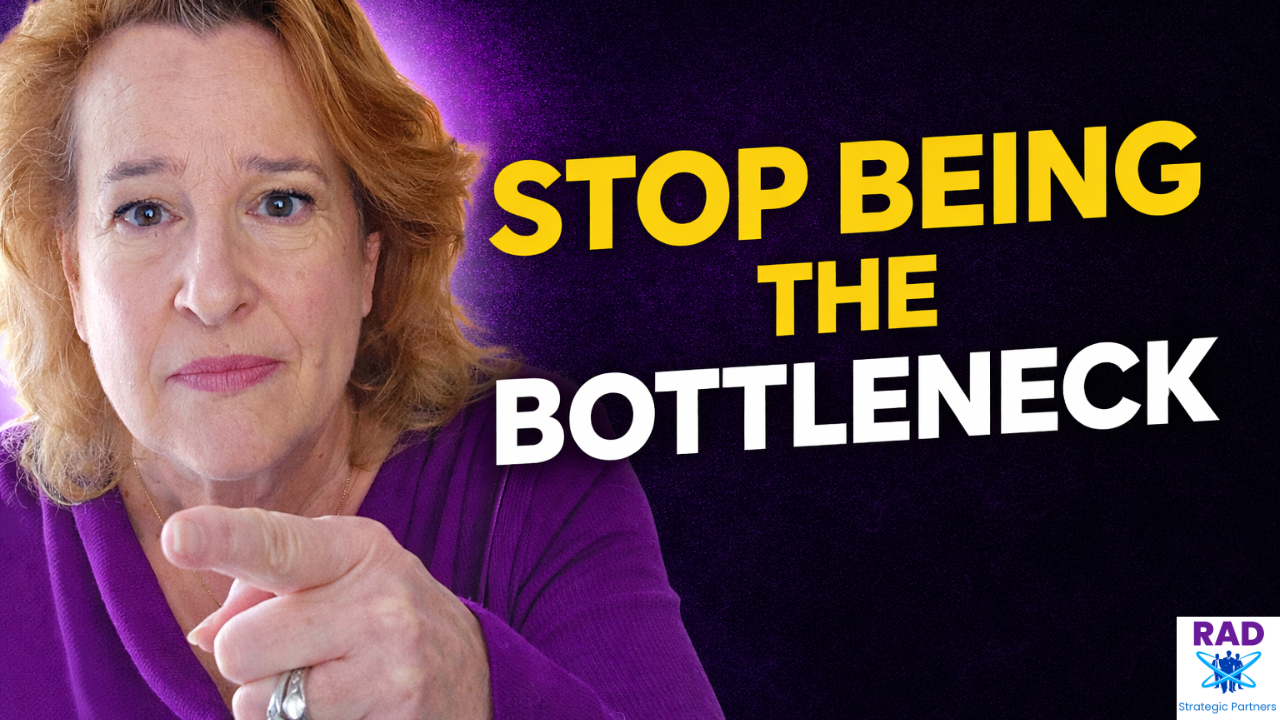
Delegate, Don’t Abdicate: How Great Leaders Escape the Bottleneck Trap Without Losing Control
If you’re the smartest person in the room, the hardest worker on the team, and the final decision-maker on everything… congratulations—you’ve officially become your company’s biggest bottleneck.
And before we get defensive (because we’re high performers and this stings a little), let’s be clear:
This isn’t a character flaw. It’s a leadership transition point.
Most business owners don’t struggle with delegation because they’re control freaks. They struggle because delegation was never properly taught—especially at the $500K–$10M stage, where complexity grows faster than headcount. (the hidden cost of being the decision bottleneck)
Here’s the truth:
Delegation done well doesn’t reduce control. It increases it.
Delegation done poorly feels like abdication—and that’s where trust breaks down, quality slips, and leaders snap delegation right back… exhausted and frustrated.
So today, we’re going to talk about how to delegate without disappearing, how to empower without chaos, and how to reclaim time without becoming disconnected from your business.
This is how strong leaders level up.
The Real Cost of Being the Bottleneck CEO
When everything routes through you, a few predictable things happen:
- Decisions slow down
- Your team waits instead of thinks
- You work longer hours but move the needle less
- Growth feels heavier instead of lighter
And here’s the sneaky part:
From the outside, it looks like dedication. From the inside, it’s unsustainable.
At a certain point, your role must shift from doing the work to designing how the work gets done. That’s not abdication. That’s leadership evolution.
Gallup research found that CEOs who excel at delegation generate 33% more revenue
Why Delegation Fails (Even for Smart, Capable Leaders)
Delegation breaks down for three common reasons:
1. We Delegate Tasks, Not Outcomes
We say, “Can you handle this?” instead of,
“Here’s the result we need, here’s how success will be measured, and here’s where you have decision authority.”
Without clarity on outcomes, people either freeze—or improvise wildly. (why only 30% of managers delegate effectively — and what separates the ones who do)
2. We Delegate Authority Without Accountability
This is the abdication trap.
True delegation requires:
- Clear ownership
- Defined decision rights
- Agreed-upon checkpoints
No clarity = no confidence (for them or you).
3. We Delegate Without Systems
If delegation lives only in your head, it’s not scalable.
If it can’t be repeated, taught, or measured, it’s not leadership—it’s heroics.
Delegate vs. Abdicate: The Leadership Line Most People Miss
Here’s the simplest way to think about it:
Delegation says:
“I trust you to own this—and I’ll stay appropriately involved.”
Abdication says:
“Good luck. Let me know if something goes wrong.”
The difference is structure.
“Strong leaders don’t disappear when they delegate—they design clarity.”
The RADical Delegation Framework (Leadership + Execution)
Let’s walk through a practical, executive-level delegation model you can actually use.
Step 1: Delegate the Outcome, Not the How
Start with:
- What does success look like?
- What does “done” mean?
- What constraints matter (budget, brand, timeline)?
Then let them own the execution.
This is where empowerment lives.
Step 2: Define Decision Rights Explicitly
Every delegated responsibility needs one of these labels:
- Decide & Inform – They decide, you’re kept in the loop
- Recommend & Decide Together – Collaborative decision
- Execute with Guardrails – They act within set boundaries
Unspoken assumptions are where delegation goes to die.
Step 3: Build in Accountability (Without Micromanaging)
Accountability isn’t hovering—it’s visibility.
Use:
- Weekly scorecards
- Milestone check-ins
- Defined review points
You’re not checking up on them.
You’re checking in on the work.
Step 4: Systematize What Works
Once something is successfully delegated, document it:
- Simple SOPs
- Checklists
- Loom walkthroughs
This is where delegation turns into leverage. (how effective delegation turns into organizational leverage and team empowerment)
And yes—this is also where AI becomes incredibly powerful when layered on top of clear systems. (how AI becomes powerful when layered on top of clear systems)
Delegation as the Gateway to Time Freedom
Time freedom doesn’t come from doing less—it comes from leading better.
When delegation is done well:
- Your calendar opens up
- Your team grows stronger
- You focus on strategy instead of fire drills
This is how leaders move from:
- Operator → Leader
- Leader → CEO
And no, you don’t lose touch with your business.
You gain perspective.
A Thought to Sit With
“If your business can’t run without you, you don’t own a business—you own a job with overhead.”
Uncomfortable? A little.
Powerful? Absolutely.
A RADical Action Plan (Start This Week)
Let’s keep this practical:
This week, do just three things:
- Identify one responsibility you’re currently holding that shouldn’t be yours
- Clarify the outcome, decision rights, and check-in cadence
- Delegate it fully—and resist the urge to grab it back
Leadership growth lives in that discomfort.
Take the Structural Independence Assessment™ to identify where delegation needs to happen first
What Comes Next
If delegation feels messy, it’s often because it’s disconnected from a bigger plan.
And if you want help building delegation systems that actually work in your business, a 20-minute Discovery call is a great next step.
You don’t need to do this alone—and you definitely don’t need to do everything yourself.
Frequently Asked Questions: Delegate, Don’t Abdicate
1. What is the difference between delegation and abdication? Delegation assigns ownership with clearly defined outcomes, decision authority, and accountability checkpoints. Abdication dumps work without clarity, support, or expectations — then reacts with frustration when results miss the mark. The difference is structure, not intent.
2. Why do strong leaders struggle with delegation? Most leaders were rewarded early in their careers for being the fixer — the one who gets it done. Delegation feels risky when no structured handoff process exists. The issue usually isn’t trust in people; it’s a lack of clarity around outcomes, decision rights, and checkpoints.
3. What should I delegate first if I’m the bottleneck CEO? Start with recurring responsibilities that consume significant time weekly, don’t require your unique expertise, and create delays when they wait on you. Admin approvals, routine client updates, scheduling, reporting, and internal follow-ups are the most common first delegates.
4. How do I delegate without micromanaging? Use visibility instead of control. Define the outcome, agree on milestones, and set a simple check-in cadence. Scorecards and milestone reviews replace constant interruption. You’re not hovering — you’re staying informed through structure.
5. What does “delegate outcomes, not tasks” actually mean? It means you define what done looks like and why it matters, then let your team decide how to get there. You provide the guardrails and success criteria — not a step-by-step script. This is where real empowerment lives.
6. How do I clarify decision rights so work moves faster? Make decision authority explicit for every delegated responsibility. Use one of three labels: Decide and inform me, Recommend and we decide together, or Decide within defined guardrails (budget, brand, timeline). When authority is ambiguous, people hesitate and speed dies.
7. What if my team isn’t ready to take ownership yet? Then delegation becomes a development plan. Start with smaller, lower-stakes outcomes. Provide templates and checklists. Increase autonomy as competence and confidence grow. The goal isn’t perfection from day one — it’s progress plus accountability.
8. How can delegation create time freedom without losing control of the business? Structured delegation increases leadership leverage rather than reducing oversight. When you’re not the approval bottleneck, decisions happen faster, your team grows stronger, and you reclaim time for strategy and high-value leadership work. Control comes from clarity, not proximity.
9. How does delegation connect to scaling a business sustainably? Businesses that depend on the owner for most decisions hit a growth ceiling determined by the owner’s personal capacity. Delegation installs decision-making infrastructure that allows the business to grow beyond what one person can process — which is the structural foundation of scalable growth.ate as CEO—and what needs to move off.